During my Costume Assistant Workshop and Workshop on creating your own Trigger HUDs, I share HUD examples. These are easy prim HUDs you wear on your screen and can create yourself. You can use these to trigger Costume Assistant changes, turn on particles that listen to chat commands, etc.
In these two examples, there are three prims – the black background and one for each of the buttons. The buttons are simply flat cubes where I’ve applied a texture, then linked the three pieces together making the black background the root prim. I then take a copy into inventory, choose to attach as a HUD and resize/rotate it if I need to.
Each button has a script in it. This is where you tell the script what channel for the shout and what to shout.
I designed these HUDs so that you can easily change the channels and shout commands, and also add additional buttons if you choose to. (Unlink one of the buttons make copies, then relink to the main prim – OR – make your own prim and just add a copy of the Trigger HUD script.)
The Trigger HUD script that goes in each button:
default
{
touch_start(integer total_number)
{
llShout(7777, “addfolder EVA BEDLAM ASYLUM”);
llSleep(3.0);
llShout(7777, “removefolder EVA BEDLAM BALLGOWN”);
}
}
Touch start tells the script “do this stuff when I’m touched”.
llShout is just that – shout this stuff. The first part is the channel number, the second part in quotes is what it should shout.
If you want a delay in between, this is what llSleep is. This tells the script to “sleep” for however many seconds you put in between the parentheses.
Each button has its own script – keeping it simple. You can make as many copies of the hud as you want and adjust the script for yourself! You can even make it shout ten things with one button!
Contact EvaHarley in-world if you’re interested in learning about creating your own Trigger HUDs.
Background: a look into my creative process as I build a dance start to finish. See previous posts to follow along if you’ve just jumped in. Welcome to my madness!
WREN HAD IT RIGHT – IT’S ALL ABOUT THE BEAT! umm…sort of
At this stage in creation, I’m spending a lot of time with the music – listening for tempo changes, transitions in the music, the chorus, feelings, lyrics, beat, and anything special – like a sudden trumpet solo for example. Bringing all of this into your choreo as you create can give your dance such an immersive feel, capturing not only the feel of the music but the lyrics and story behind it too. To me, music is like a painting that is heard instead of seen. Choreo can be too, but just like paintings if you focus on one color too much (like just the drum beat), you miss all the other amazing colors weaving together.
I’ve been very fortunate, some music experience RL, but also learning under two different instructors about music for dance in SL. They both took very different approaches to it, neither was wrong in their methods and applying them together works well for me. I’ll try to keep this simple, because I’d hate to explain something incorrectly. The first instructor taught a lot about musical theory – bars, measures, phrasing, counts, upbeat and downbeat, time, and how these apply to dance. In most pop music, there are 4 beats per measure, and 4 measures is one phrase. Lyrics usually also follow along with the phrases, if you listen to the song above you can hear the natural breaks/changes between phrases. Each measure has 4 beats – and each beat has an upbeat and downbeat. Listening to this song, can you feel the beats? 1 – 2 – 3 – 4 – 5 – 6 – 7 – 8?
This instructor created her choreography by listening for and studying the timing, the beats, the phrases, her choreography flowing with it and animations often changing at the beginning of a phrase. I still “count” the beats, listen for them in my head – especially when the music is a bit different and the timing changes in the middle. I think many people do this same thing without realizing it.
What I learned from the other instructor is incorporating the transitions of the music in my dance, changing the tempo of my animations for interest. Feeling my story behind the music and identifying the emotions I want to express. To mix up animations – not be afraid to use a folk dance for a pop song, not to limit myself to jazz animations for a jazz song for example. The other thing he expressed was incorporating the lyrics in the choreography, adding another dimension. If the lyrics include “beating heart”, this may be a great place to use a dance animation the presses the hands to the heart…if it fits.
My belief is sharing what we know, teaching and learning from others, and encourage everyone to grow and adapt that knowledge in their own way. For me, the important thing I’ve also embraced is that this is not a formula. That if we try too hard to always match the animations to the lyrics, always start animations on a new phrase, always choreograph exactly to the beat, always follow a direct interpretation of the lyrics instead of our own ,- this can become algebra instead of art. There shouldn’t be any “always” when it comes to choreography. Ever.
This is the point I sit back, let myself completely relax, and let the music flow over me. See?
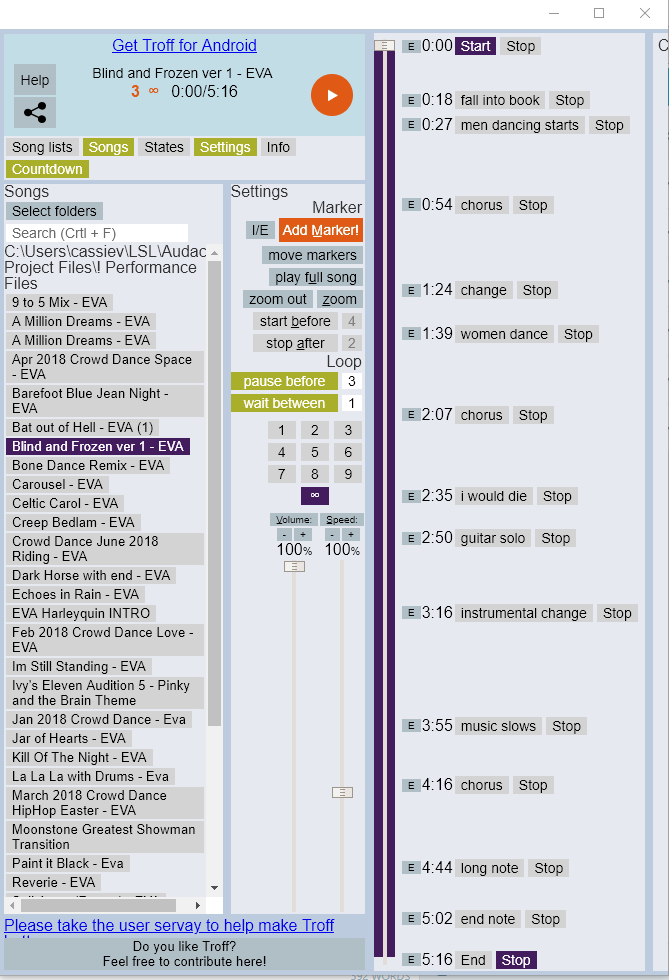
I’ve always made notes as I planned out my choreography. In the beginning, I’d print out the lyrics and then drew lines, made scribbled notes, and doodled all over. Now I use TROFF, music listening software that’s designed for training with music. You can set it to repeat the selection, count in (great for choreo – you have a few beats before it starts the music). You can also add labels, notes, and select the different sections to play. This is handy if you need to keep repeating a section for choosing or working with animations.
So, in Blind and Frozen, there is the beginning and the ending that I’ve marked for the special entrance through the book, and the ending coming out of the book. I won’t be dancing in those parts, so I don’t need to choose dance animations for them.
I like to free-write my ideas for a dance, but try not to get too rigid when planning the music. Sometimes the choreography takes on a mind of it’s own and I’ll adjust or flip things along the way. I keep it simple when making the notes on the music – so that I can easily read it and choose the important points and sections. So here’s what my dance and change ideas look like:
This music will definitely be a bit of a challenge because there are three/four very distinct tempos – At 3:55 especially, the music has a slower tempo – a bit emotional? While the song is high intensity which is one of the things I love about it, there are still tempo variations. The non-chorus parts, like when the men start dancing at 0:27 is what I consider the baseline tempo. The chorus ramps up from that tempo. The instrumental change at 3:16 almost takes on a frenzied feel, and the part at 3:35 is slower than the “baseline” tempo. While I’m choosing animations I need to keep these various parts in mind. For some songs, I actually split the music in half and choose the animations separately. I hope not to do that for this one.
This is the dance/music brainstorming I did in post #4 and is still my rough plan.
——————————-
Blind & Frozen (Dance plan):
extend the sound in the beginning of the song, open the curtain to present day, a book opens, light shines out. Move closer, during the long note disappear into the book.
Background/story behind the dance – multiple lifetimes, love, passion, strength, give and take.
Land in a castle type room, open, chandeliers, candles, dramatic lighting, set to midnight, very specific and ornate pieces – these will carry back at the end. I land in a kneel, two other female dancers are with me. Three male dancers are the focus, I am a bit disoriented at this point – expressed through slow walk, slow pose, the women and I moving into place – closer but separate from the men. My costume has changed – hopefully through fades so that it’s instant.
[note to self – for other dances – change it up, not all intense story lines like this and Riddler!]
Dancers: me, two other women, 3 men. All main costumes are medieval yet still modern. My starting and ending costume is present day – must change really fast. Men’s are strong, black/earth colors. Boots. Women are in dresses – must flow well, show legs during dancing…no stretchy mesh. Shoes – boots. Male & Female costumes mesh together.
dancing starts – men. while they dance, men approach the women, I back up behind other two women. During chorus men turn and move forward to front center stage, main male dancer turns – doing a different animation and looking at me. During the chorus, women start to dance, not right at the beginning of the chorus but more subtle, not sultry but not as strong as the men.
During the long note, women move forward, use the power of the instrumental beats to take center stage. Men move back and to the side. Offset formation? At this point, I’ve “transitioned” from current time to the past – like previous life memories. Women are the main focus, men dancing secondary. At the start of the chorus, the men come forward and we all dance together, very strong – single animations. Use formations – don’t want it to feel all partnered at this point.
what if the castle seemed old after falling through the book, then begins looking like it did in the past during the dance? Shedding cobwebs, copies of props that are darker – maybe use a script to change the tint from darker to white in a slow transition, maybe even some shine?
At I would die – men and women in pairs turn and dance in opposition. Cut out guitar solo or most of it? Is it worth the work for 25 seconds? Is there something I can do with it?
At 3:16 and quick instrumental changes, add a lot of mover movement across the floor, wild dramatic dance moves and formation changes. This lasts for 40 seconds.
Music slows, change into couples animations for slow part and chorus? After chorus switch to single animations. At end note, dancers disappear, set fades, and the original set in present time appears. I appear kneeling on the floor, light effect out of book dims and the book closes. Special objects in the room glow as they fade in – these are heirlooms from the past that appeared in the castle. Also include a pile of old letters – have them spill out of the book? Or a particle out of the book? Maybe even a key?
At the end, leave it hanging – did they rekindle their love or did she walk away? Have a dramatic pose and pause where you’d expect her to turn to him…leave it unfinished.
During the change in the music….the set starts to fade out in pieces before everyone’s eyes leaving little but me and the lead dancer. During those last beats of the music, I’m falling back out of the book.
According to my roadmap chart below, I lost a little time finishing this piece. I should be able to pick that back up by finishing the picking of animations tomorrow. My key is making sure I DO do it, and that I also spend the right amount of time to pick the right animations – not rush it and think of the deadline before the dance.
I guess I should get out of the hammock now, eh?
Happy Dancing!
~ Eva
—————————————–
Blind & Frozen Timeline
Start date – 6/2
Performance date – 7/13
Finish Day
Goal
Date
Done
1
6/2
Choose the music
6/2
1
6/2
Buy or download the music
6/2
2
6/3
Write up an outline for the dance, background, the story, ideas, feelings, how many dancers, etc.
6/3
4
6/5
Edit the music (if needed)
HOLD
4
6/5
Pick a costume, or something similar to what will be my costume
We’ve all done it – we’re trying to jump on a dance mover and we can’t find it. It’s just nowhere, the choreographer is doing their best to direct you, but you just can’t get your camera to zoom in on it let alone sit on it. Worse is when you keep getting that lovely blue spinning circle every three seconds of camming. In less than a minute I’m begging for wine or just about ready to release a string of curse words that would make a sailor blush.
I am also a blogger for Dance Queens where every week or so the Dance Queens audience can find a little of my madness. Plenty to go ’round. Happy dancing!
Capture a special moment each day, something different, not for a nice photo but something that inspires or invokes feelings of creativity, peace, passion. To help keep me moving forward, working past challenges and to discourage me from hiding in my protective shell.
Background: a look into my creative process as I build a dance start to finish. See previous posts to follow along if you’ve just jumped in. Welcome to my madness!
MUSIC, ROAD MAPS, AND….COSTUMING <eek>!!
So, in post #4 I mentioned how I’m not fond of the 25 second guitar solo and how I want to extend the beginning and end of the music for the dramatic open and close of the performance. Next on my roadmap is editing the music, but I decided to put this on hold for now. Why? For the start and finish, I’ll be in a contemporary room with a magic book. All of the animations will be expressive – walks, poses, falls… not really dancing. I’m not going to focus on that yet, I want to focus on the dance itself – I can easily add that part in later. For the guitar solo? I could possibly edit it out, but cutting out the middle part of a song can be a real challenge sometimes. Either I need to splice it very carefully so no one notices the missing part, or I need to add some kind of fade/pause/sound effect to mask the change. After some thought, I decided I’ll start working on the choreography and see how it starts coming together. I might make where the guitar solo is be a dramatic change in the dance and use a sound effect, some special action in the dance, and cut out the guitar solo. Make it a pivotal moment. This gives me a little more flexibility too – going back to a previous verse in the music, instrumental, a sound effect, extend a fade or maybe have some of the guitar solo fade into the background and layer another sound over it. Pregnant pauses can also add such a dramatic impact in the dance! I’ll need to wait and see what the dance speaks to me when I get to that point. Not everyone edits their music. Sometimes I do, sometimes I don’t.
Ok, that decided I moved on to finding my costume or something similar. For women, animations appear so much differently depending on the costume.
Example:
A recent performance I’m so thankful to have danced in with Gracie Lyonesse – choreographer
You’re the One That I Want performance – photo credit: chopper Gurbux
I’m sure you can see how significantly different animations would appear for the two different costumes. Not only do you have the flow of the skirt layers on the right and the limited exposure of the legs, but you have the general feel of the costumes too. To me, animations appear to be sexier, risque when wearing the costume to the left – for various reasons. When watching the same animation in the full dress, the animation can take on a more subtle yet passionate feel or you might not even be able to see most of the movement at all because the dress may obscure it (which can be good or bad!). This is why I always work on choreography for a dance wearing my dance costume or something similar to what I expect to wear.
Side note: I’m finding that working with this new timeline/roadmap is really keep me on track and focused, but almost making me want to rush so I can put that “checkmark” in the done box. I did mention I’m Scorpio, a procrastinator, and yet a little OCD too right? It’s a conscious effort to make sure I don’t rush to get the pieces done and that I do it right. I’ll get used to it I’m sure. I think it’s an ingrained “reward” signal, making lists and crossing off what’s been completed – kind of like Pavlov’s experiment? Hmm….
Back to to the costume…
So, in post #4 I listened to the music over and over again and wrote my thoughts, ideas, the story and feelings within the dance. Because the dancing is set in the medieval period, I wanted a dress that was similar to that period of time – long, flowy, good movement, yet a bit untraditional – not overly modest. I also knew I wanted two other female dancers with me.
Finding a long dress to use in a dance can be a real challenge, especially with a mesh body. Why? You want a dress that will move well. If you use a long mesh dress, it generally won’t have a sense of movement, and it will just stretch as you move. Many long medieval dresses are older and still don’t have appliers. Even if they do have appliers, I don’t always like the look on my Maitreya body. Most of all – you don’t want a dress that looks like it’s eating you as you dance. Long flexi skirts may move while you dance, but they can also become distracting, jarring, and completely obscure you! You don’t want people to zero in on your dress like a train wreck, just waiting to see what strange things it will do!
For the dance above where I wear the flowy dress, my costume almost became a piece of the choreography, an identity of its own. Like another dancer, the movement of the dress as it flared, how it slowly settled and stilled during the dramatic pauses in the choreography became part of the dance itself. In Blind and Frozen, there are more dancers and a more intricate set. The dress will still be part of the whole, the way it moves will impact the overall performance, but it won’t have quite the same focus.
So, my considerations/preferences when wearing long skirts in a dance:
at least some flexi for movement. May be a single skirt over a mesh dress/skirt or just a flexi skirt. Sometimes even multiple overlaid flexi skirts.
when the skirt moves, is it too jarring/distracting. Does it seem to flow naturally? Am I being obscured in a really bad way?
Are there pants/glitch pants under the skirt? What does it look like when I run animations? Do my textured legs stick out, the skirts trailing behind in a strange way?
Does the long skirt have a slit on the side to expose the leg(s)? This can be great for breaking up the long skirt and adds interest to the choreography as skin is revealed/hidden.
I almost never wear just a long mesh skirt/dress for a dance. If I consider it – does it stretch in a strange way? Appear unnatural?
If I’m wearing a mesh dress/skirt under flexi skirts, how does it look as I run the animations?
Did the outfit come with multiple layers so I can choose how many/what skirts to wear? Is it copy so I can wear two nearly see through flexy skirts on top of one another to give me a look I like?
Is the dress/skirts modifiable so that I can change the length of the skirt panels – shorten them to expose a bit of ankle/leg?
A lot to consider isn’t it? The other challenge is, many demos only include the mesh pieces for testing fitting, not the flow of the flexi parts. I must admit I have quite a few “well that didn’t work” outfits in my inventory. To help avoid this, I study the marketplace listing carefully, try the demo if I can, but also keep a list of some of my favorite clothing creators. Good fit, great design, good quality textures can make such a difference in costuming.
Disclaimer here: honestly, costuming may be one of my least favorite parts of creating a dance. It’s always a challenge for me to put together an outfit in SL – just like it is in RL. The eye for composition, details, gut instinct is less intuitive for me as I’d like it to be. It’s an amazing feeling when I do put together or create a great costume. I generally have a few missteps along the way…but I own that and know it’s part of the creative learning process. This is why I will probably never teach a workshop on costuming. I do sometimes read articles and blogs about costuming in RL. It actually crosses over into SL, believe it or not.
Other things I consider when costuming: colors and textures. I haven’t built my set yet, but I have a general idea of my colors and textures. In this case, the set will be stone walls, traditional wood pieces, rather muted. I want costumes that will stand out from the set, be noticeable, yet fit into the overall color scheme. Neon green just wouldn’t work for this dance. For color, I also consider the emotion too and if I will be dancing with others. Do I want to stand out from them or should we all look similar except for hair, etc.? Here the dance will include men and women, which means I need to consider male costumes and male mesh bodies too. (I’ve been slack lately – not creating dances that include men recently just because of that.)
For me, if I’m dancing with other women, I generally try to use the same creator as the maker of my dress. It may be a different color, a different style, but the overall structure of the costume will be similar. There’s a huge difference in texture quality, shades, detail of the costume pieces between creators. Sometimes it’s the same creator, sometimes different ones, and sometimes I even combine pieces from two different creators together. When I get to finalizing the costumes, I’ll paste in some examples.
So, all that being said, I’ve picked the main part of my costume:
The pictures don’t do it justice. I still need to accessorize, may lift up the skirt on my hips a bit, but overall I loved the flow of it and all the options I have with it. It has appliers and mesh pieces, multiple options for tops/skirts/scarf/gloves. It took me a while to play with it. It’s not modifiable which I wish it was, but I think it will look and flow well for the dance.
That decided, I went ahead and looked for dresses for the other two women. I wanted them to look similar yet different to me. I wanted them in another color. I think this is the main piece they will wear:
This is the same dress I’m wearing, but in a different color. The white version looks significantly different yet still similar to mine. They will be wearing a different combination, probably the one on the farthest left without the belt (but with the waist band). I don’t use the arm flexis, they almost always just get in the way.
There is a gold version of this dress, which may complement mine better as it picks up the gold in my skirts, but with the white the dancers and I stand out more from each other. I think I’ll wait until I finish at least the main set design before choosing.
One last comment about costumes? These dresses aren’t cheap, 549L each which can add up over time. When I can, I like to use full perm templates/mesh pieces to make my costumes. This makes it easy to distribute to my dancers (copy/mod, not transfer) and to use different dancers each time. Personally, I generally provide the costumes to anyone dancing with me. Sometimes one I’ve made, sometimes loaned (if I own transfer versions), or most often sent as gifts from marketplace. This plus the other creation costs is how I use any tips I may get. Sometimes the costume I really want to use is a bit on the expensive side. For these, I try to use the same dancers in repeat performances. For one special performance, there were six dancers. Two of the completed costumes approached 2k lindens and were no transfer. For that dance it was completely worth it to me and my creative choice. I am so exceptionally thankful to all my dancers and anyone who dances with me, and I know I’m not always the easiest choreographer to work with so it is the least I can do. This was my personal choice, and as with everything depends on the costumes, the dance, etc. Dance is an SL can be an expensive hobby ~ every choreographer should always feel comfortable doing whatever is right for them when it comes to costumes, tips, etc.
That’s it! I have the main piece of my costume. Next I’ll be listening to the music at a “deeper” level and noting the chorus, instrumental parts, changes in tempo, beats, lyrics, etc – then on to choosing the animations.
Happy feet!
~ Eva
Blind & Frozen Timeline
Start date – 6/2
Performance date – 7/13
Finish Day
Goal
Date
Done
1
6/2
Choose the music
6/2
1
6/2
Buy or download the music
6/2
2
6/3
Write up an outline for the dance, background, the story, ideas, feelings, how many dancers, etc.
6/3
4
6/5
Edit the music (if needed)
HOLD
4
6/5
Pick a costume, or something similar to what will be my costume
Background: a look into my creative process as I build a dance start to finish. See previous posts to follow along if you’ve just jumped in. Welcome to my madness!
STORYBOARD! (aka – what the heck am I gonna do with this song)
You know, I was just thinking (I do that a lot, my brain doesn’t shut off very often…). If you’ve ever created a dance, you’ve created a storyboard in your own way. Maybe it was in your head, or scribbles on a piece of paper, chatting with a friend, or maybe random notes you wrote down.
A storyboard is kind of an outline of what your dance will be. I’m sure we’ve all doodled dancer waypoints/routes/movements/set ideas while distracted before!
Before I start tossing costumes, props, and and animations around, I like to free write ideas, thoughts, feelings about the dance. Usually my ideas evolve as I explore and write. I keep these ideas, expand on them, cross stuff out, write different ones in…sometimes I even toss out the original ideas as new ones are born. Soooo much easier doing this now instead of after the set is done and I detest it. 🙂
When I create, I refer to it as “breathing life” into my dance. Honestly, I create for myself first – the whole experience, from thought, to birth, to development, to fruition. My hope? to enjoy the creativity, new ideas, choreography that takes my breath away, and a dance I love and want to share. To feel, to laugh, to experience emotion – whatever it is.
If you haven’t heard the song I’m working on, I’m keeping a youtube link to it at the bottom of these posts.
I like to free write my ideas by typing them in a private blog I have. I type faster than I write, plus I can paste links, pictures, costume ideas, etc. As always – do whatever works best for you! I’m an unabashed geek – and have now decided I want a graphics drawing tablet so I can really doodle here! I’ll drool over them on Amazon in a while…but I have a very important mission here. Free writing my dance ideas! These will help direct the rest of the flow of the dance…so super important!
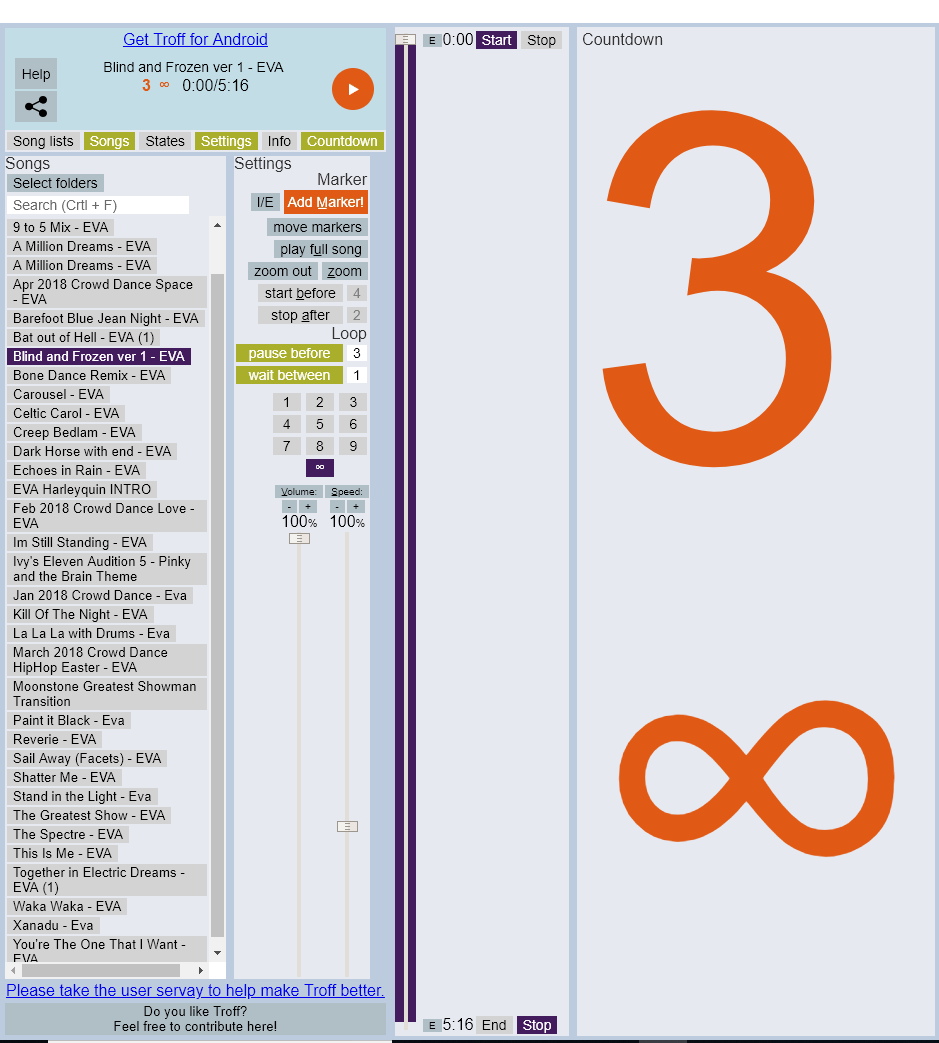
First step, while I brainstorm I listen to the music over and over again. Remember the comment I made about choosing a piece of music you can listen to over and over again? If I shudder at the thought of it, I immediately toss that song on the “no” pile. I like to use Troff to listen to music for a dance, and I can click on the infinity button to keep it endlessly repeating. Troff has a 3 second countdown which is great and can use the space bar to start and stop. When I get to the actual choreo, I’ll be using more of Troff’s features. While brainstorming I also start and stop the music a lot as I capture ideas about different pieces of it.
Below is how I write out my dance ideas for my own use. Not pretty, but not meant to be.
Never stop listening to the music in your head. 🙂
~ Eva
Blind & Frozen:
extend the sound in the beginning of the song, open the curtain to present day, a book opens, light shines out. Move closer, during the long note disappear into the book.
Background/story behind the dance – multiple lifetimes, love, passion, strength, give and take.
Land in a castle type room, open, chandeliers, candles, dramatic lighting, set to midnight, very specific and ornate pieces – these will carry back at the end. I land in a kneel, two other female dancers are with me. Three male dancers are the focus, I am a bit disoriented at this point – expressed through slow walk, slow pose, the women and I moving into place – closer but separate from the men. My costume has changed – hopefully through fades so that it’s instant.
[note to self – for other dances – change it up, not all intense story lines like this and Riddler!]
Dancers: me, two other women, 3 men. All main costumes are medieval yet still modern. My starting and ending costume is present day – must change really fast. Men’s are strong, black/earth colors. Boots. Women are in dresses – must flow well, show legs during dancing…no stretchy mesh. Shoes – boots. Male & Female costumes mesh together.
dancing starts – men. while they dance, men approach the women, I back up behind other two women. During chorus men turn and move forward to front center stage, main male dancer turns – doing a different animation and looking at me. During the chorus, women start to dance, not right at the beginning of the chorus but more subtle, not sultry but not as strong as the men.
During the long note, women move forward, use the power of the instrumental beats to take center stage. Men move back and to the side. Offset formation? At this point, I’ve “transitioned” from current time to the past – like previous life memories. Women are the main focus, men dancing secondary. At the start of the chorus, the men come forward and we all dance together, very strong – single animations. Use formations – don’t want it to feel all partnered at this point.
what if the castle seemed old after falling through the book, then begins looking like it did in the past during the dance? Shedding cobwebs, copies of props that are darker – maybe use a script to change the tint from darker to white in a slow transition, maybe even some shine?
At I would die – men and women in pairs turn and dance in opposition. Cut out guitar solo or most of it? Is it worth the work for 25 seconds? Is there something I can do with it?
At 3:16 and quick instrumental changes, add a lot of mover movement across the floor, wild dramatic dance moves and formation changes. This lasts for 40 seconds.
Music slows, change into couples animations for slow part and chorus? After chorus switch to single animations. At end note, dancers disappear, set fades, and the original set in present time appears. I appear kneeling on the floor, light effect out of book dims and the book closes. Special objects in the room glow as they fade in – these are heirlooms from the past that appeared in the castle. Also include a pile of old letters – have them spill out of the book? Or a particle out of the book? Maybe even a key?
At the end, leave it hanging – did they rekindle their love or did she walk away? Have a dramatic pose and pause where you’d expect her to turn to him…leave it unfinished.
During the change in the music….the set starts to fade out in pieces before everyone’s eyes leaving little but me and the lead dancer. During those last beats of the music, I’m falling back out of the book.
_______
Dancers: 3 men, 3 women (including me)
Costumes – all dancing will be done in the medieval/tudor style costumes
Animations – opposition, mirror, single, couple.
Set – two main sets, contemporary room, small. Inside a castle keep – stone walls, stone floor. Tapestries, candles, chandeliers…what else? Not over full but not empty either.
Movement – will be a lot of waypoints in this one.
Effects – book opening and aura that spills out, castle that goes from “old” to brighter/cleaner, change of set, fade out of castle keep slowly. Add a frame for the edges of the set that gives it an older feel? like a vision? heirlooms that glow as they appear at end. Dramatic lighting for set. Advanced lighting?
Blind & Frozen Timeline
Start date – 6/2
Performance date – 7/13
Finish Day
Goal
Date
Done
1
6/2
Choose the music
6/2
1
6/2
Buy or download the music
6/2
2
6/3
Write up an outline for the dance, background, the story, ideas, feelings, how many dancers, etc.
6/3
4
6/5
Edit the music (if needed)
4
6/5
Pick a costume, or something similar to what will be my costume
I think I’ve always chosen the music before a set idea comes into my head. I work based on “feel” a lot – when I hear a piece of music, sometimes I just “have to” create it. I like to listen to it over and over again, letting thoughts and ideas, visions come into my mind.
My favorite times are when it’s almost subconscious – feeling it, seeing the dancers in my head, flashes of the set. I listen, again and again…letting it speak to me, and sometimes…it gives me chills. That’s part of the thrill of this I think. When we create we are truly diving into the music, becoming one with it. Sharing a piece of ourselves. At least for me, even when I don’t intend to, I’m sharing a piece of myself, a glimpse of my inner self. I think for everyone it’s different, and every performance is different. Not all dances have to be super serious – and I hope they aren’t! We don’t have only one emotion – so our dances shouldn’t either I think. Recall the performances you’ve seen, the ones that stick in your mind. How did they make you feel? Yesterday I cried. I was thrilled, I felt pride and solidarity, I felt unique and powerful through an incredible dance of another, and I laughed. All in one show while sitting in the audience, different choreographers, every one bringing a piece of themselves to the stage. Even now I have chills.
Whew…ok. Back to choosing music! A song usually hits me because there’s a feeling or a message in it. My general guidelines – no rules! I’m a Scorpio, I detest rules and control (really!).
Pick a piece of music you can listen to 762 times and not hate it. You will be listening to it that much as you create! Sometimes even just little pieces of it…over and over and over again….and over and over and over and over….
If you are a new choreographer, I’d recommend choosing an upbeat dance music piece. You will find this style the easiest to find animations for, hooks, and changes in the music that automatically create great variations to keep your audience focused. They will also probably be somewhat familiar and will find it easier to connect to. In general, you might find it more enjoyable and confidence building to start here too.
I tend to choose music that has changes in the tempo, the beat. If it’s all monotone, it can be very hard to choreograph, and especially hard to keep the audience from zoning out. I love the hooks, chorus’ that grab you, music that makes you feel. The audience may not know that specific piece of music, but they can connect to it. Remember, guideline not rule – right? While it can be an extreme challenge, I’ve seen incredible performances to music that you’d never expect!
Consider where you will perform your dance. Will the audience there be able to relate? Sometimes I create with a venue in mind. Sometimes I create because I need to and figure out where to perform it later.
Do you feel the music? Does it drive you to create? I’m a very emotional person, and this reflects on the way I create, why I create. Figure out what drives you…and then does the music feed this?
I love this video…and there really is some truth in it!
So, I’ve had this piece of music waiting for a long time – until the right time. I knew it needed more time develop, and that it was going to be a challenge. I’d actually heard it long before I added it to my “to create” music. One day it just clicked, I could see it in my mind. Those ideas and visions always change as I create, but I could feel it and it hasn’t left me since. Now, the dancers in my head are saying it’s time. (You do remember I’m a proud fruit loop, right?) ha!
So, like I mentioned in the previous post, this is my song:
It is a bit heavy, may be a bit unexpected for the audience. There are definitely venues where this dance will not fit – especially small stage burlesque type venues. I chose it because of the feeling, the story, the chorus. It grabs me and won’t let go. So – this stirs a thought in my head. I love this song, it’s drawn me in. Who am I creating for? Will the audience feel it, or will it be too jarring when they hear it for their first time?
I think it’s good to go outside your comfort zone, stretch, challenge. The truth is, sometimes my creations are all I want them to be, sometimes they work, on occasion they don’t but I’m ok with that. You never know unless you try, put it out there. One of the most incredible examples of this is a performance by JP Damien and his dancers at Phoenix on June 2nd, the song: Portugal. The Man – Feel It Still (ZHU Remix). I hope everyone gets the chance to see this incredible performance. He embraced his creativity, put it out there, and completely brought the house down. I still have chills and hope to see it again!
To me, Blind and Frozen has great changes in the music, tempo, hits, chorus. I’m not so fond of the 25 second guitar solo. In this case, I’m hoping to edit it. Some choreographers edit their music, many don’t. That is definitely not a requirement, but is a great skill to learn. Simple edits like adding a sound effect at the beginning, or trimming a long fade at the end can be extremely handy to know how to do.
Now that I’ve chosen the music, I always recommend getting a copy of it. As a DJ, it can be extremely hard when someone has choreographed from a youtube video. Youtube videos can have varying quality, there can be over a dozen versions of the same song – all different, and sometimes it’s nearly impossible if not impossible to download it. I always purchase the music when I can – the single mp3 from Amazon. I own it, choreograph it, and I can send it to the DJ knowing they will be playing my version.
For this song, the video on youtube has added sound effects that I want that aren’t on the original mp3 so in this case I downloaded it. (Note: I did also purchase a copy of the mp3 for my own listening – support your music artists!)
So, I’ve chosen my music and I’ve downloaded a copy. Check and check on my timeline!
Breathing deep and enjoying what I do, my way
~ Eva
“Blessed are the weird people: poets, misfits, writers mystics, painters, troubadours for they teach us to see the world through different eyes.”
~ Jacob Nordby
Blind & Frozen Timeline
Start date – 6/2
Performance date – 7/13
Finish Day
Goal
Date
Done
1
6/2
Choose the music
6/2
1
6/2
Buy or download the music
6/2
2
6/3
Write up an outline for the dance, background, the story, ideas, feelings, how many dancers, etc.
4
6/5
Edit the music (if needed)
4
6/5
Pick a costume, or something similar to what will be my costume
Here we go – now’s the time for me to plan out a timeline. I’m going to think of them like video game save points, check points to make sure I’m moving along and see where I get stuck. Tough part? I tend to underestimate how long something will take. I think the more I do this though, the more accurate my timing will be. Hmm…this reminds me of a book I read – but I can’t remember the title. I’ll have to look on my Kindle…later! (remember, the queen of procrastination? lol)
I’ll be keeping this on the bottom of every post. I know, I know! It seems kind of technical/work like….and I’m always mentioning the creative flow! Do you need to create a timeline like this? Definitely not! Is it good to have a plan? Definitely – but use whatever methods work for you! I can be easily distracted, tend to procrastinate, so this timeline is a tool for me to keep me on track. Never ever let tools overcome your creative passion or suck up the time when you could be creating. If something feels awkward, ask yourself this: is it awkward because it’s new and you haven’t grown comfortable yet? or is it awkward because it just doesn’t work for you, the way you think, the way you work? Always remember, we all think differently, create differently. What works for others may not work for you. Your creative process is your own – always.
Here we go!
~ Eva
Blind & Frozen Timeline
Start date – 6/2
Performance date – 7/13
Finish Day
Date
Done
1
6/2
Choose the music
1
6/2
Buy or download the music
2
6/3
Write up an outline for the dance, background, the story, ideas, feelings, how many dancers, etc.
4
6/5
Edit the music (if needed)
4
6/5
Pick a costume, or something similar to what will be my costume
OK, so in my previous post I decided to keep working on Kill of the Night, but to use the creation of this performance to blog my journey start to finish – good, bad, and everything in between! Why you wonder?
a. it’s an awesome way for me to consciously think about how I create, see where where I stumble, hit road blocks, and what jump starts the creative juices and ideas.
b. maybe by blogging my creative journey, maybe it will either: help others to begin or keep going when the going gets rough OR share a few lessons from my stumbles, twists, and turns.
Blind and Frozen by Beast in Black, to perform Friday the 13th of July. Gives me just about 6 weeks to create. I do admit that many choreographers create faster, some seem to create truly incredible acts week after week. For this one, I wanted to give myself extra time to:
truly bring my creative vision to life – no pressure inducing deadlines
take time along the way to blog the process
I’m hoping to add some things in that I haven’t done before – need extra time to work that out too
and last but not least – I’d like to completely wrap it up 1 week before the first practice…so that gives me about 5 weeks.
So what song am I going to do? I’ll share it in a minute, I promise! I am almost always inspired to create after hearing a song…even if I’ve heard it before, sometimes it just clicks in place. I also have a list of songs I’d like to create a performance for, and sometimes revisit those. Maybe one jumps out, maybe one doesn’t. What almost never works for me? Picking a song just because it fits a theme.
So, as I promised myself in my last Kill of the Night post, I’m going to create a plan and a timeline this time – goal posts to make sure I’m staying on target, but have a little bit of wiggle room too when I need it.
ROUGH OUTLINE:
choose the music
buy or download the music, and edit it if needed
write up an outline for the dance, background, the story, ideas, feelings, how many dancers, etc.
pick a costume, or something similar to what will be my costume
listen to music for dance and change ideas
choose animations
work on choreography and record
build set
finalize costumes
create style cards for dancers
plan out movers and create routes
test and adjust movers and choreography
add effects
test and adjust
pack up set
test again 🙂
make any final adjustments
take copy of set and movers into inventory
I probably won’t do everything in this exact order, but it’s pretty much the flow I follow. I find that for women, animations look different depending on the costume, so I like to wear something close to what I envision for the final costume. Sets and costumes can sometimes be a real challenge for me…so hoping I can keep the inspiration going and not get stuck!
Tomorrow I’ll add some “checkpoint” dates to this list and start marking it off.
So…the song I picked, which I will edit. I’m hoping I can smoothly cut out the guitar solo. Doesn’t quite fit for me, and I’d like the dance to be under five minutes. Here it is! More on why I chose it in the next post.
Eva Harley is the person behind the avatar, or is that the avatar behind the person? I exist in all worlds, I am simply me. Find here random thoughts, feelings, information, ideas, possibly inspiration, and hopefully laughter and smiles. I embrace the unusual, long to be within the world yet also outside of it, watching and marching to my own drum, creating my own beat. This is my canvas, Second Life the world between worlds that is my playground. My life is what I make of it, and here I share for both you and I alike.

 HUDs, I share HUD examples. These are easy prim HUDs you wear on your screen and can create yourself. You can use these to trigger Costume Assistant changes, turn on particles that listen to chat commands, etc.
 and one for each of the buttons. The buttons are simply flat cubes where I’ve applied a texture, then linked the three pieces together making the black background the root prim. I then take a copy into inventory, choose to attach as a HUD and resize/rotate it if I need to.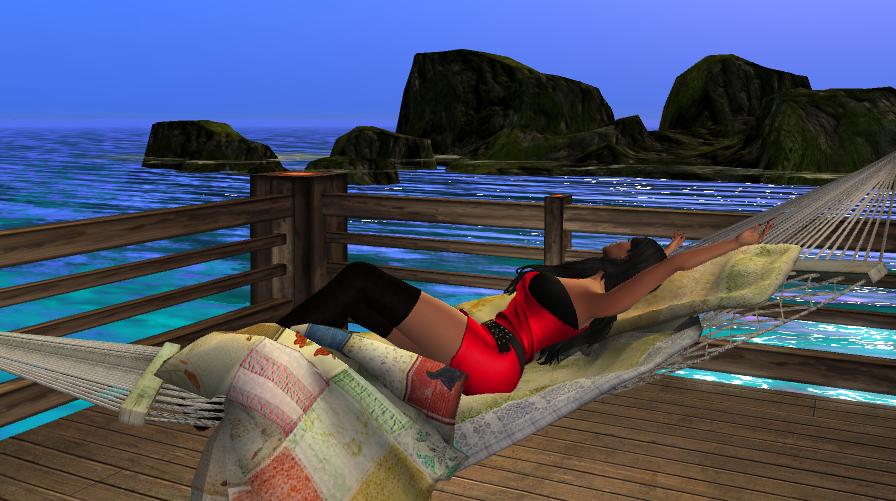



 Madness, Matter, and Rambling Thoughts